by Kaybe Wong
When talking about Japanese artists, you must have heard this name, Yayoi Kusama, “who was a self-described “obsessional artist.”[1] She is well known by “her immersive installations that explore ideas of infinity and obliteration.” [2] She obsessed with using polka dots and nets in her artworks.
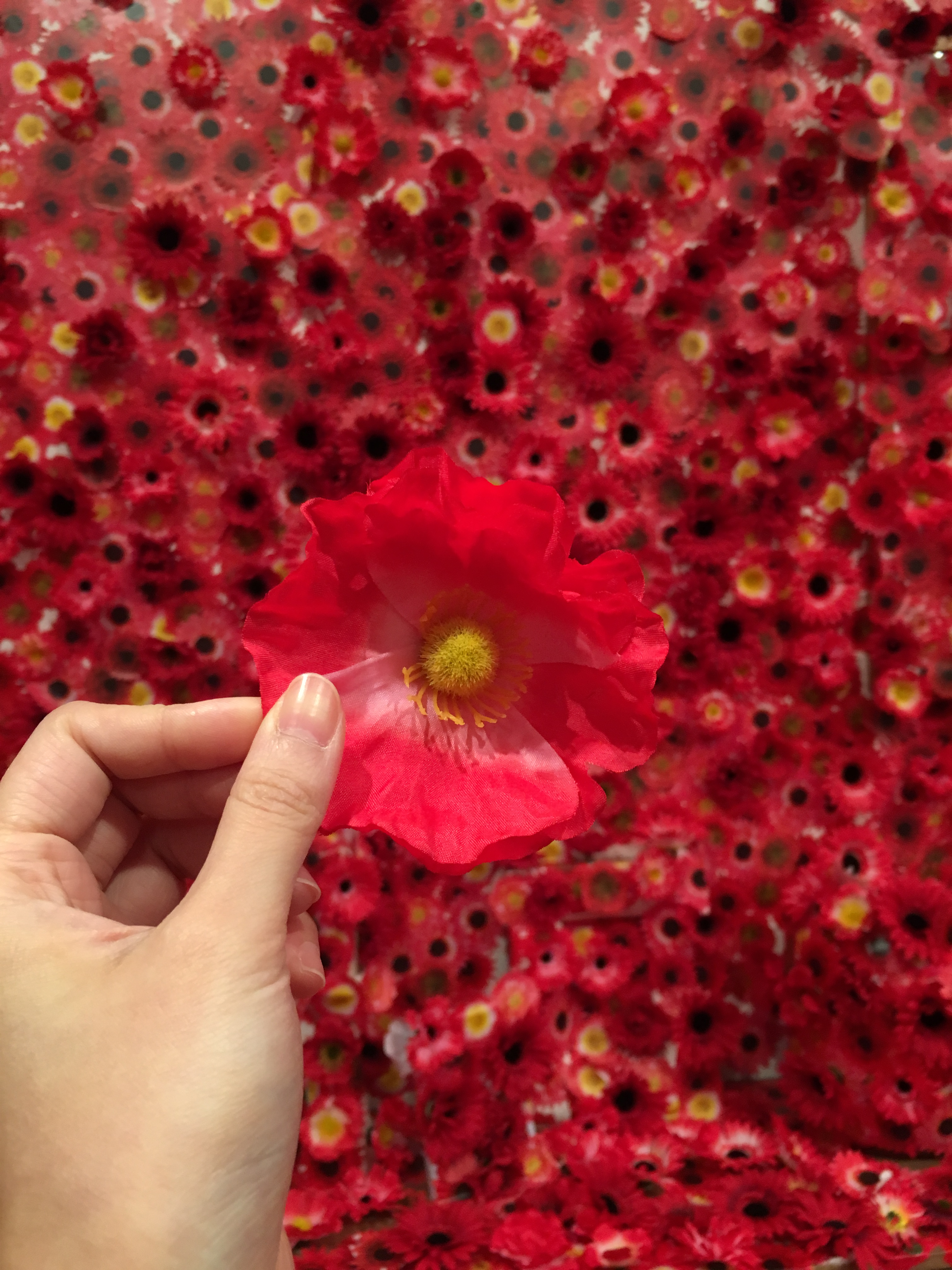
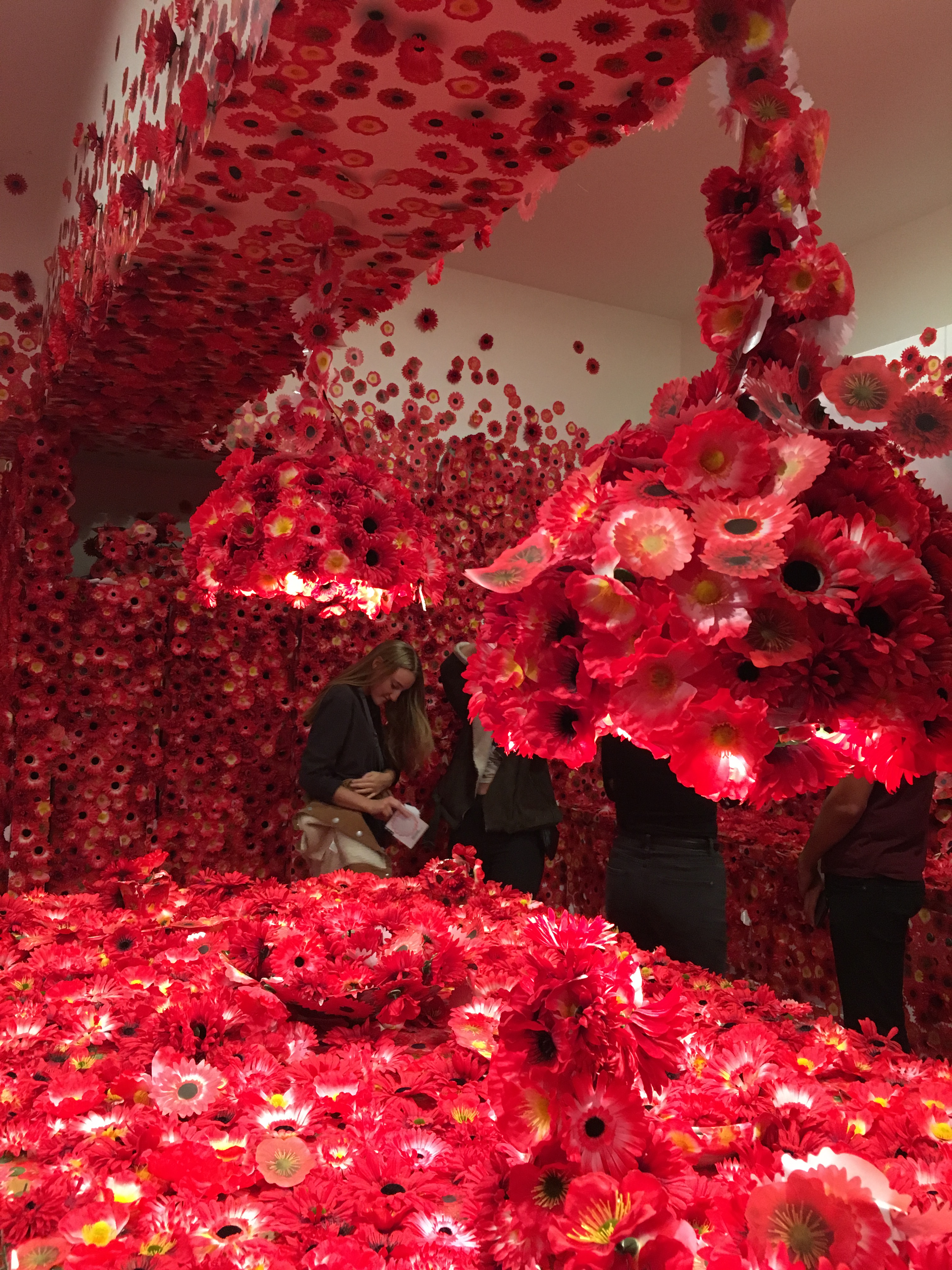
Figure 1 & 2. Photos I took in the NGV
During 15th December in 2017 to 15th April in 2018, there was an exhibition done by her was held at the National Gallery of Victoria (NGV) in Melbourne, which is the Flower Obsession. The concept of this exhibition is similar to her other exhibition, The Obliteration Room, which is to invite the audience to engage and complete the artwork. Kusama has been experiencing vivid hallucination since ten years old, and this idea is inspired by one of her childhood experience. One day she was gazing at a table towel with red flower pattern, and suddenly the entire room was filled with red flowers, even her body as well.[3] In the Flower Obsession, Kusama created a furnished space in the NGV, the audience will be given a red flower sticker to stick anywhere in that space, in order to make the space filled with red flowers and transform the space into a spectacular and unique environment. This kind of art is called Participatory Art, “it is a term that describes a form of art that directly engages the audience in the creative process so that they become participants in the event.”[4] The aim is to “increase awareness of audience participation in the co-creation of meaning”[5], and the exhibition is more emphasis on the interaction with the audience but not the overviews.
I went to the exhibition in February, and I was excited about it because I always like Kusama’s works such as the dotty yellow pumpkin and The Obliteration Room , however I had never got a chance to see her artworks in person. Therefore, I was really excited when I knew that she was holding an exhibition in Melbourne.
Before everyone got in, we got a red flower sticker, which let visitors stick in the space. When I first stepped in the space, I think it is amazing and spectacular, which you cannot feel it by just looking at the photos on Instagram. The space was actually like a house, there was a table, chairs, sofa and even a toilet etc. The entire space was filled with red colour, and when you look closer, you can see they are all red flowers, the plastic one and the sticker one. And of course, I sticked my red flower sticker on the wall as well! However, a friendly reminder that you may get a bit scared if you have Trypophobia. Moreover, I think the space of the exhibition can be larger because it was crowded that my friend and I could not walk into some popular photographing spots, for example, the bathtub.
Flower Obsession was very successful, there were “more than 550,000 stickers were affixed to the surfaces of an ordinary apartment.”[6] Besides the popularity of Kusama, I think the reason why Flower Obsession is remarkable because of the concept of the exhibition. It is a participatory art, which let the audience engage in the artwork, participate in the process of creating it. This kind of interaction is more impressive than just looking at an amazing painting or art piece, as the audience create the artwork as well, it is their artwork too. Therefore, that’s why I still remember how the exhibition looks like after a year because I participated in creating the Flower Obsession too!
[1] Rachel Cole, “Yayoi Kusama | Biography, Art, & Facts”, Encyclopedia Britannica, Last modified 2019, https://www.britannica.com/biography/Yayoi-Kusama.
[2] “Artists | NGV”, Ngv.Vic.Gov.Au, Last modified 2019, https://www.ngv.vic.gov.au/triennial-voices/artists/?a=58.
[3] Kate Sierzputowski, “Yayoi Kusama’s ‘Flower Obsession’ Invites Guests To Cover A Domestic Interior With Faux Blossoms”, Colossal, Last modified 2018, https://www.thisiscolossal.com/2018/04/yayoi-kusamas-flower-obsession/.
[4] “Participatory Art – Art Term | Tate”, Tate, Last modified 2019, https://www.tate.org.uk/art/art-terms/p/participatory-art.
[5] Matthew Holt, “Transformation of the Aesthetic: Art as Participatory Design.” Design and Culture 7, no. 2 (2015): 143-65.
[6] Ben Neutze, “The NGV’s Triennial Is The Gallery’s Most-Visited Exhibition Ever”, Time Out Melbourne, Last modified 2018, https://www.timeout.com/melbourne/news/the-ngvs-triennial-is-the-gallerys-most-visited-exhibition-ever-041918.

 Design Practices
I’ve also been to this exhibition and her art and designs are extraordinary to many. The Red Flower room I can agree that it was engaging to the audience. The sense of being a child again, the use of the red flower stickers made it more playful as to where to place the sticker as well as making the place very unique and spectacular.
Noticing Yayoi’s obsession with polka dots, viewing Figure 1 and 2 either up close or from afar, the centre of the daisies do remind me of polka dots.
Learning that she experienced vivid hallucinations since of young age (10 Years Old), I didn’t think many artists and designers would get their inspiration from their childhood. Also being called “Participatory Art”, it is not targeted towards designers or artists, it engages with everyone’s creative mind.
I liked how you added a brief explanation of when you went to the exhibition and I can agree that the area could be expanded for more space. Taking photos for their social media, the use of ordinary house hold objects and stickers allowed the interaction to be more interesting and allowed us to create our own artwork in the process too.
LikeLike