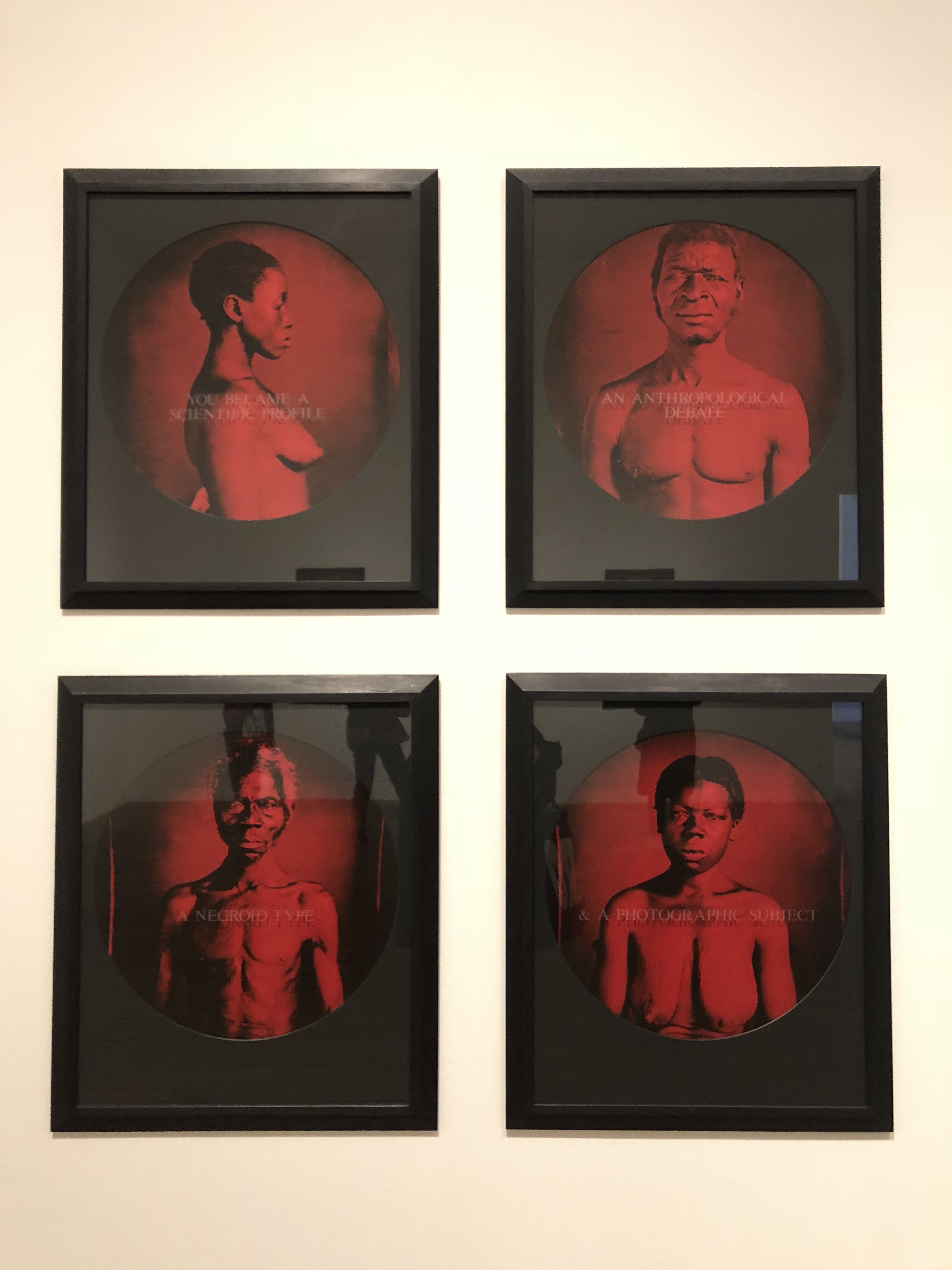
During my time in England in late October of 2018, I attended the Tate Modern, a large well known museum of modern art, where Carrie Mae Weems’ “From Here I Saw What Happened and I Cried” series was displayed. The collection of photography was shot by Louis Agassiz in the 1950s as a means to show the relationship Anglo-America had with their slaves, however Carrie re-photographed the images through a red filter and engraved captions in order to give a voice to the African American people [1].
The red filter in the photos reflected a very raw and serious emotion from the Indigenous subjects. It emanates a shockingly confronting image, especially alongside the bare nude nature of the subjects. Many of the subjects in the images stared back at me, with intensity yet silence, unable to voice their hurt. The engraved captions complimented the images by supplying volume to the spoken silence. In their vulnerable states, we are able to receive communication and story from those who never had such opportunity. It is a retelling of experiences, but that are not to be taken lightly, as they carry suffering, pain and loss.
The Australian Indigenous Design Charter of Communication Design (AIDC:CD) was developed to reinforce need for equality and appropriate cultural representation in design. Through this process it is recommended that Indigenous projects should be Indigenous led, and that Aboriginal and Torres Strait Islanders should be included more in any Australian design process. Through the International Indigenous Design Charter (IIDC) it is clear that such intentions are to be reflected internationally towards all Indigenous cultures.
The nature of Weems’ work reflects the intentions of the AIDC:CD, as it emphasises the urgency of not overlooking the past traumatic experiences of others and that through appropriate design processes, it is possible to achieve inclusivity, equality, higher ethical standards and respecting cultural ownership.
Juliana Luna Mora’s The Yoga Industry, discusses the glorification of the yoga industry, and how a form of exercise has become a multibillion dollar industry [3]. It is disappointing to see a practice morphed into a ways of consumerism. It is equivalently disappointing when Indigenous art is appropriated into stereotypical objects such as souvenirs and generic prints, so it is pleasing to see Weems make a stance like this and demonstrate the importance of the perspective of the Indigenous people themselves and to not let them be overlooked.
Weems, being an African American woman herself, clearly draws from her desire to appropriately represent where she came from, and although her work may be confronting and saddening, it does get the message across. I am glad that she passed on these messages. From seeing this, and learning about the AIDC, I am learning more and more about the appropriate representations of Indigenous cultures and feel more confident in how to go about the design process when such cultures are involved.
[1] Museum of Modern Art, Carrie Mae Weems: From Here I Saw What Happened and I Cried, date accessed: 1 April 2019, https://www.moma.org/learn/moma_learning/carrie-mae-weems-from-here-i-saw-what-happened-and-i-cried-1995/
[2] Indigenous Architecture and Design Victoria, Design Institute of Australia, Deakin University – Institute of Koorie Education, School of Communication and Creative Arts. Australian Indigenous Design Charter – Communication Design.
[3] Juliana Luna Mora, “The yoga industry: a conscious luxury experience in the transformation economy,” (PhD thesis, Monash University, n.d.)

 Design Practices