Huijun Huang
On the 21st of March 2019, I went to visit an exhibition held in National Gallery of Victoria, which called “Designing Women”. It displayed roughly 30 pieces of work, all created by female designer. The exhibition was located on level 3 of the gallery.
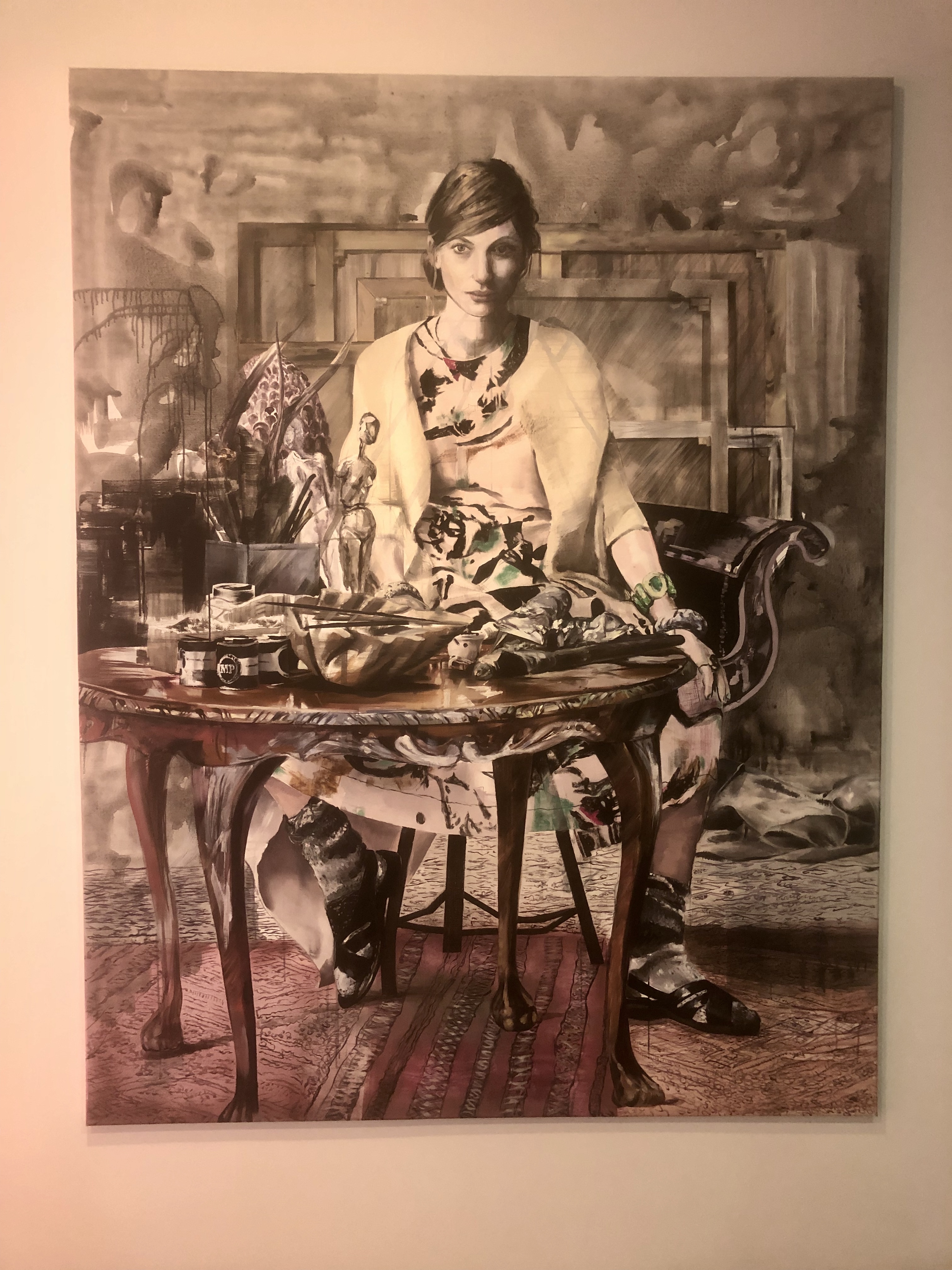
The painting “The painter”(figure 1) was the first work I saw before I entered the main area of the exhibition. It was created by Paulina Olowska, who is a painter, photographer and filmmaker. Olowska used to “give back a voice to those who have been excluded or forgotten, in particular women of the socialist era in Poland”[1] in her works. This information makes me think that the female in this painting might also be considered as “forgotten” one. So that is the reason Olowska has drawn her. As an audience, I do not know who the lady is in the painting and the story behind her. However, in the painting, the way of lady sits on the chair with legs apart and no emotion on her face, makes her look powerful and independent. It could be designer’s decision which has made us view in her designed way of seeing. Just as what John Berger has written in his book, “The painter’s way of seeing is reconstituted by the marks he makes on the canvas or paper”[2]. In addition, the placement of the artwork may also influence the way we view this artwork or the role of female in the painting. In my opinion, the way lady sits has already differed her from those ladies on usual traditional female portraits. The lady is looking straight at the audience which generates pressure on the viewer. Olowska has chosen to mainly use grey colours on this work, both at the foreground and background.
Olowska’s painting was the only graphics work which has displayed on exhibition. Other works are mostly either industrial or fashion design. It was surprising to see much successful industrial designs created by women at present. As according to a previous statistic, “ The Design Innovation Group’s… between 1982 and 1984 showed that in a typical sector, office furniture, 72% of firms employed in-house industrial designers but only one company employed a woman in this capacity.”[3] So where were all the female designer in the past decade? I found the answer after I read a wall text at the exhibition. This was shown under the section of “Teamwork”, which listed out a few designers’ names “who all experienced relative anonymity when co-designing with their better-known husbands.”[4] We all have to know the fact that we are still live in a patriarchy society since six thousand years ago, which means in some cases, men are still think as better than women. In my opinion, this exhibition was a successful one. Especially, the way they have displayed the works which have lead audience to view the exhibition in their designed order that they want viewer to perceive. The result from doing this gives audience a better experience. Designer has put those selected interesting design everywhere around the room, so audience would not get bored even it takes a while for every one of them to finish seeing all the works. I wished to see more great female designed work in other exhibitions. This kind of exhibition has empowered me, to feel more confident to work as a female designer both now and in the future.

References:
- Culture.pl, Paulina Ołowska, accessed 25th, March 2019, https://culture.pl/en/artist/paulina-olowska
- John Berger, Ways of seeing, London: British Broadcasting Corporation and Penguin Books, 1972, 7
- Margaret Bruce & Jenny Lewis, women designers-is there a gender trap, Butterworth&Co(Publishers)Ltd, 1990, 114-115
- National Gallery of Victoria, Teamwork shown at Designing women Exhibition, Contemporary Art & Design: NGV Australia, 28 Sep 2018 – 29 Sep 2019. Visited on 21st, March 2019.

 Design Practices
I love the artwork that you picked and talked about the painting in depth with the colour, the placement and the meaning within it. The most interesting thing to me is about how the world is changing right now, women has their own right and freedom to sit however she likes even when she is wearing a dress or how the way she poses its not to be judge or be stereotype. I realised the direction of where the world is heading is something that all designers should be consider. I also really like how you used statistics to support your points on women designers were not being recognised within the industry. It’s amazing to see an exhibition was made all by women designers/artists, especially within the industrial industry. Even until now, a lot of people still put labels on this particular industry saying that men have the privilege working on 3D models or programming but I said “It’s not true.” There are so many wonderful women designers out there (including students) that worked not only within industrial but others like coding, IT and so much more. So I believed that the world is definitely changing and we, as a female designer, should be proud of who we are and what we created.
Pin Chen Chen (Joy)
LikeLike