By Sarah Toal
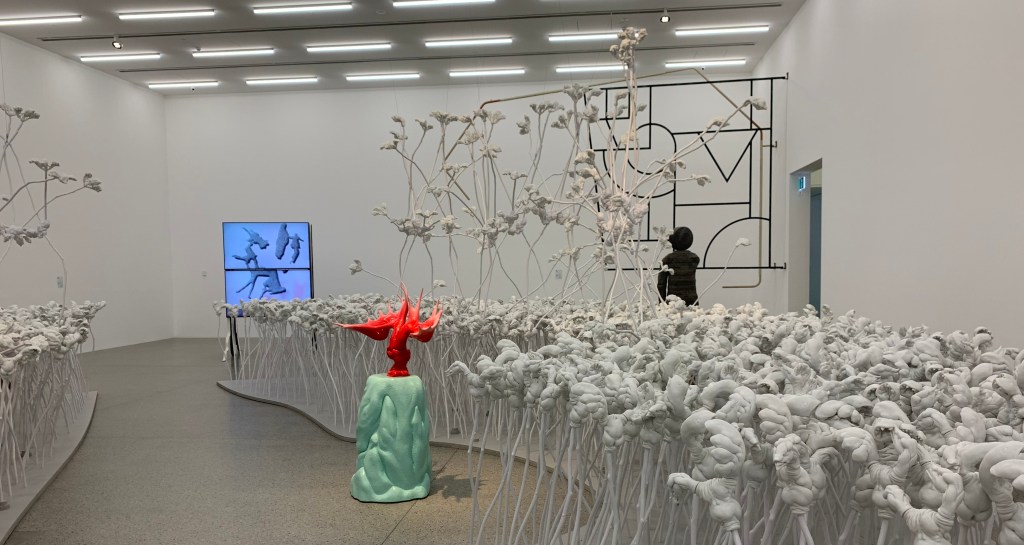
Eerie yet beautiful. These were the first notes I wrote upon entering the “ENTER” exhibition in Kew, newly curated by the Lyon Housemuseum. As I walked through one of the major rooms of the small exhibition I couldn’t help but notice a violin playing faintly in the background, which was surprisingly not intended to be part of the piece that struck my interest the most. It was hard to miss the sculpture that took up a large portion of the space in the room. The piece in question had a boldly coloured pair of red antler-like structures emerging from a red boot, sitting upon a turquoise rock. However, this was only one part of the piece as it sat within a moderately sized walkway in a large, white, field-like environment. However, I couldn’t quite figure out what the field consisted of despite the sculptured figures being incredibly detailed. My initial reaction to this piece was that although it was grand and aesthetically pleasing, I couldn’t identify the underlying meaning. However, upon reading the guide I received on entry the messages became clear.
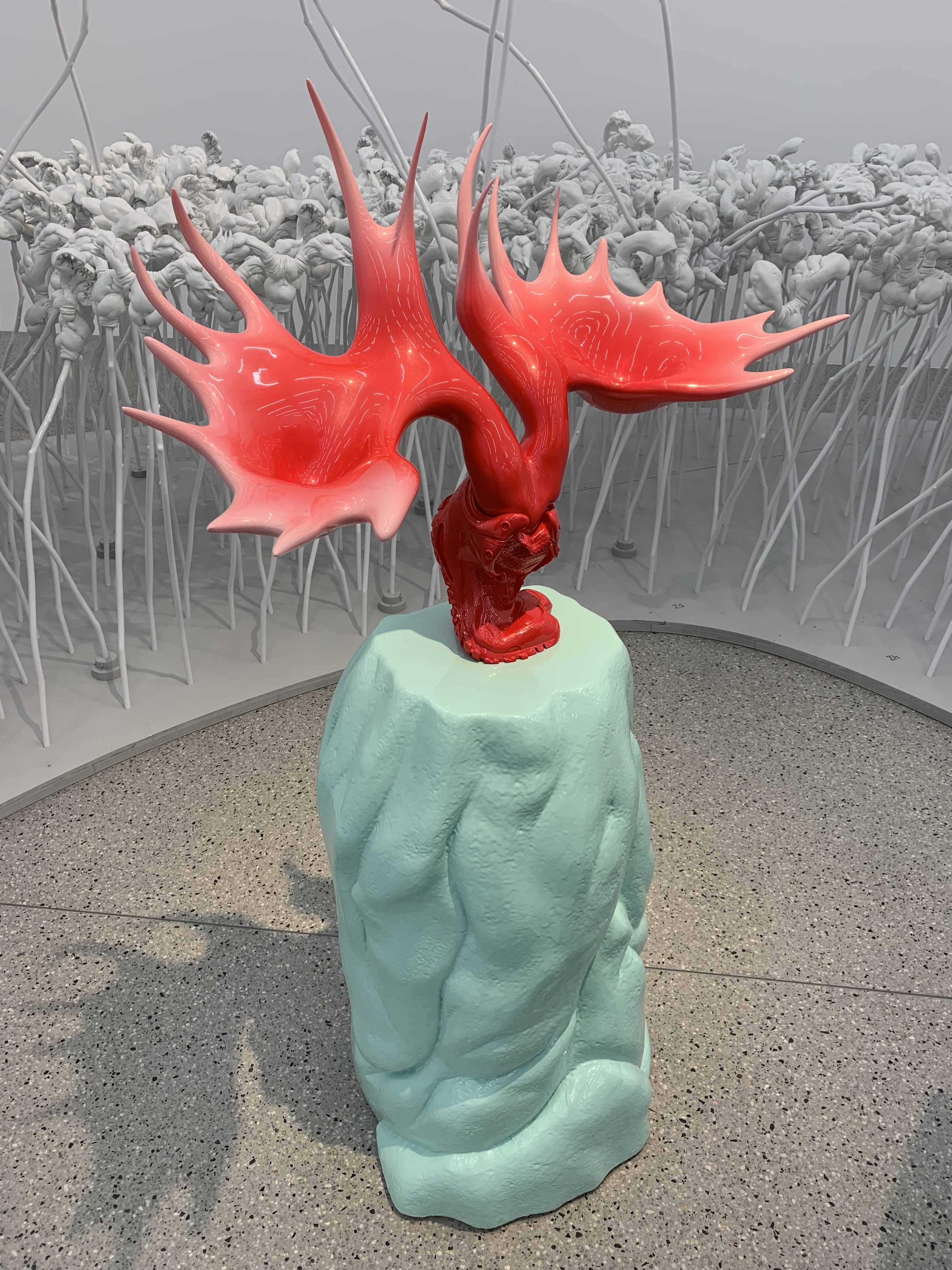
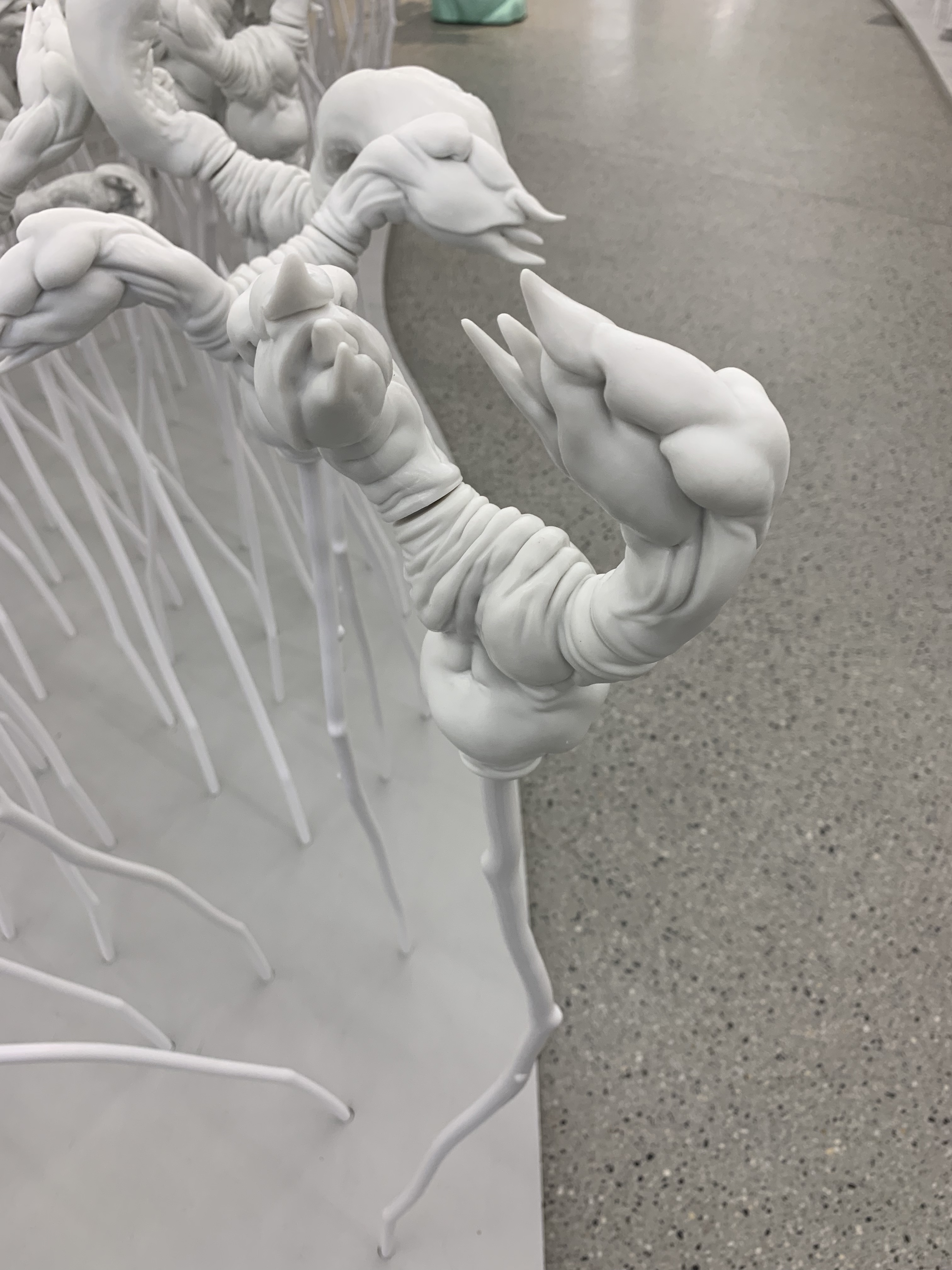
This piece is titled “The Clearing” by Patricia Piccinini, a contemporary Australian Artist and one of the few selected to take part in the ‘ENTER’ exhibition. Piccinini asks her viewers to question the idea of nature within our contemporary world. Her proposition is that we need to have a better understanding of our constantly moving modern world and change the way we think about nature to protect what’s left of it [1]. Piccinini also proposes that the field consists of flowers, all the same yet positioned differently to appear as though they are all different, an attempt to embody how nature is complex despite being represented in a simple environment [2]. These statements allowed me to further my understanding of the underlying connotation, as I initially didn’t have, as Bourdieu states, the ‘cultural competence’ or the ‘code’ to which was required in deciphering the underlying meaning of this piece [3]. What she has stated refers directly to aesthetics, we are focussed on how the piece looks and fail to consider what is being symbolised, to which I am guilty of. An art principle used within “the Clearing” is contrast, commonly represented by using a coloured object within a white space, as it has been used here. In my case, I focussed on the coloured object as it stands out, with the white field being a secondary thought despite it exploiting a large area within the exhibition. This is a metaphor for how we perceive the world, we are so focussed on what is right in front of us, or what is considered materialistic, that we fail to realise what surrounds us, that being nature. ‘Critical designers do not suggest what is the preferable future according to them; they encourage the society to reflect on it’ although Piccinini isn’t suggesting how to effectively improve our focus on nature, she is calling her audience to begin to recognise what is beyond the modernistic world we have become consumed within [4].
References:
[1] Lyon Housemuseum, The Clearing 2019. Didactic booklet to accompany the piece “The Clearing” 2019 presented at the ENTER Conversation exhibition, Housemuseum Galleries: Lyon Housemuseum, 16 March – 21 July 2019. Visited 30 March 2019.
[2] Ibid.
[3] Pierre Bourdieu, Distinction: A social Critique of the Judgement of taste (France: Harvard University Press, 1984), 2.
[4] Liene Jakobsone, “Critical Design as Approach to Next Thinking,” The Design Journal 20, no:sup1 (2017): S4259.

 Design Practices
I pass this museum almost every day as it located in the suburb where I live. However, I have never been inside nor have I seen any images of the artworks within the exhibition before. How you described the exhibition as “eerie and beautiful” as well as highlighting the presence of background violin music, both urges and encourages me to visit this exhibition in the near future.
As the image of the piece titled “The Clearing” by Patricia Piccinini was placed at the beginning of the blog, my attention was initially drawn straight to it. Similarly to you, at first I struggled to figure out what exactly the artwork was about and the meaning behind it. But this curiosity I had developed excited me to further read on, and I was gladly pleased that you explained the meaning of the piece later in the blog. I had never considered this concept that you highlighted; that we predominantly focus on what is in front of us while our surroundings such as nature are slightly blurred. Hence, this has made me aware and taught me to begin focusing more on my surroundings and to “recognise what is beyond the modernistic world”.
Overall, I believe your insight on this exhibition was significantly interesting however, to further develop your blog, you could have explored and discussed more of the atmosphere of the exhibition; such as the amount of people in the space with you or you could’ve taken note of the differing expressions other viewers showed as they observed each artwork.
Comment written by Ciara Commane
LikeLike