
I am currently working on a conceptual project for a studio unit in my third year study of communication design at MADA, under the title Pupils. The project is an instigation of a longing for discussion, questioning, answering and unity; inspired by the work of the designer Ken Garland, specifically his manifesto First Things First.
Garland initially published First Things First in London in 1964 across multiple international design journals – it was later revisited and updated again in 2000. Achieving significant acclaim and sparking controversial reactions from the international design community, Garland’s reflective thoughts on the purpose and practices of a designer called for a reformation. According to Rick Poynor (1999): “It is no exaggeration to say that designers are engaged in nothing less than the manufacture of contemporary reality” [1]. Garland challenged this very statement in his manifesto thirty years prior, and still does to this day; writing a follow-up response to his initial manifesto in 2012 entitled Last Things Last. Garland presents a final critique on his original philosophy with regard to the coming generations of designers and the future; how our relationships with “the ruthless exploiters of our skills”, or ‘clients’, should be viewed as a collaborative partnership with an opportunity to do good things [2].
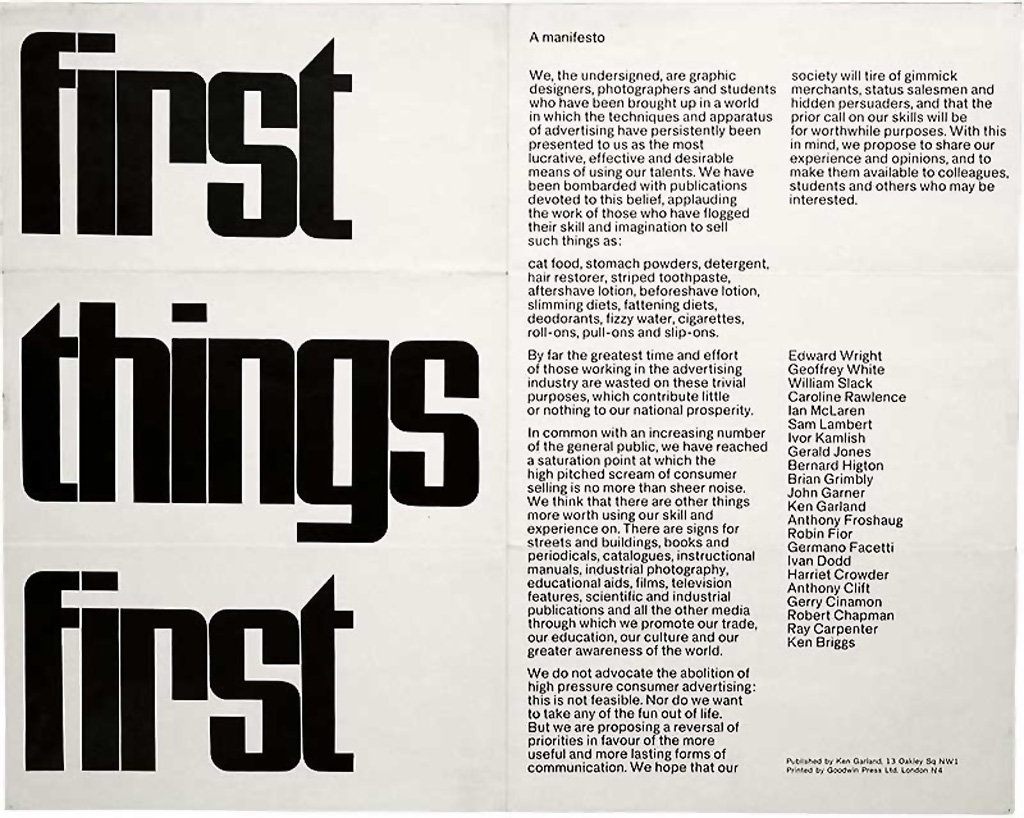
Ken Garland
In response to First Things First and Last Things Last, the purpose of my project is to investigate and propose a need for discussion about the journey from design degree to design career and the trials and tribulations faced along the way. Targeting design students within the MADA community and abroad, the outcome of the project sees to create an open and friendly forum environment for students to ask questions, discuss, debate and talk about a future in design; with aid of guest speakers and industry mentors to provide insight and experience. Pupils forum is a solution to a personal and colloquially need for an environment that builds thought, consideration and identification of our responsibilities as designers, and how we may address and better serve the community with our abilities.
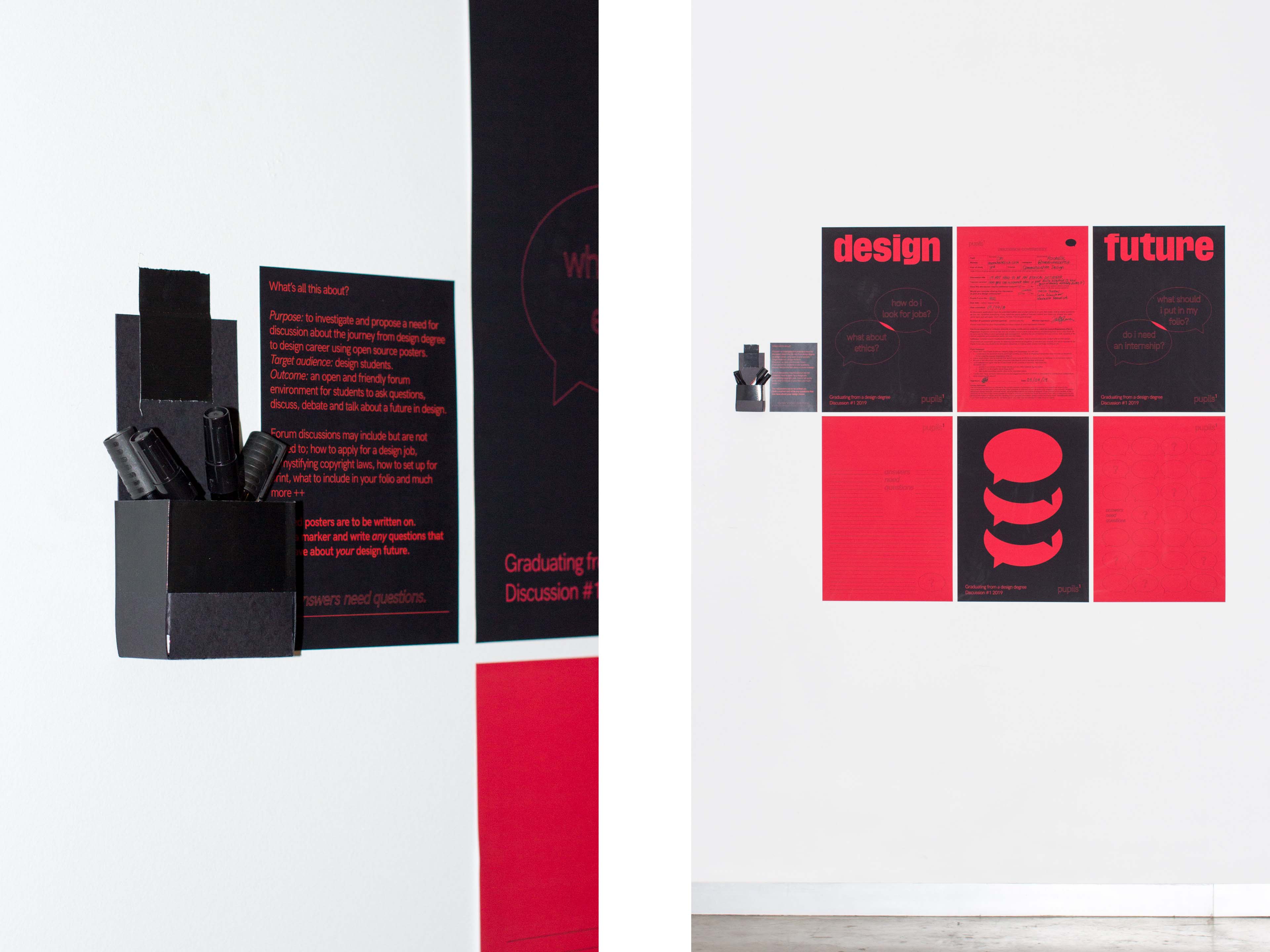
Photography and design by Alexander Rothmeier
Through an array of ‘open source posters’ I have created a direct link of interaction between the supposed Pupils forum event, specifically it’s discussion content, and the design community within MADA. Black markers are provided beside the posters, to enable and encourage students to write any design related questions or thoughts they have onto the red posters. These questions are to be then transcribed into discussion material to be brought to attention at the proceeding Pupils forum.
Similarly to the concepts of participatory design presented by Matthew Holt in his writing Transformation of the Aesthetic: Art as Participatory Design, the Pupils poster series aims to work as both an ‘incomplete’ participatory design (PD) tool that involves input from a community audience in order to achieve an ‘informed’ outcome: the forum discussion. “The basic definition of PD is that it involves people in the design process who have a stake in the outcome of the design from the very beginning, rather than being an end-user or a temporary source of feedback in the development stage” [3].
According to Jamer Hunt: “Design without both material and social impact in the world would not be design; designers must act in the sense that their outputs change the facts on the ground” [4]. I as a design student benefit from the incite of my colleagues, their questions and answers, and the guidance from my academic superiors – the Pupils project is a vessel to achieve challenges such as those posed by Hunt, and ultimately, that of the philosophies of Garland; it provides an opportunity to learn and to grow.
References
[1] Poynor, Rick. First things first Revisited. Emigre 51. (1999).
[2] Garland, Ken. Last Things Last. Eye: The International Review of Graphic Design. 21, no. 83. (2012): 79.
[3] Holt, Matthew. “Transformation of the Aesthetic: Art as Participatory Design.” Design and Culture 7, no. 2 (2015): 65-143.
[4] Hunt, Jamer. Prototyping the social: temporality and speculative futures at the intersection of design and culture. (2011): 35-36. Cited in Clarke, Alison J. Design Anthropology : Object Culture in the 21st Century. Edition Die Angewandte, University Press. Wien; New York: Springer, 2011.
Also
Jakobsone, Liene. “Critical Design as Approach to next Thinking.” The Design Journal 20, no. Sup1 (2017): 4253-262. Fry, Tony. Design Futuring: Sustainability, Ethics and New Practice. Australian ed. Sydney: University of New South Wales Press, 2009: 2-46.
Fry, Tony. Design Futuring: Sustainability, Ethics and New Practice. Australian ed. Sydney: University of New South Wales Press, 2009: 2-46.

 Design Practices