Written by Ciara Commane
Exhibition: Escher X Nendo, Between Two Worlds
National Gallery of Victoria
2 Dec 2018- 7 Apr 2019
Walking into the first room of the Escher X Nendo: Between Two Worlds
exhibition at the National Gallery Of Victoria, I could barley catch a glimpse of the first artwork. There were masses of people filling the entire exhibition space (Figure 1). I joined the long line of viewers that moved parallel with the artworks at a significantly slow pace due to the high level of involvement and appreciation every person adopted as they analysed all of Escher’s pieces.

To my disadvantage, I had only heard of Escher’s name before but I wouldn’t have been able to link any of his artwork to his name or have been able to describe the style of his designs. Thus, I entered the exhibition with no prior knowledge, attitude or expectations and I left with a new appreciation for him and his ability to showcase his passion for illusion artwork through these unusual and attention grabbing pieces.
The overall experience of walking through the exhibition was strengthened by the background music of Bach, filling the space, expressing a sense of calmness and focus. I was fascinated by the fact that Escher loved the music of Bach and that it inspired him to make images (National Gallery Of Victoria, Escher X Nendo, Between Two Worlds Exhibition: NGV Australia). Escher believed that symmetry, rhythm and repetition were shared qualities that both Bach and his art expressed (National Gallery Of Victoria, Escher X Nendo, Between Two Worlds Exhibition: NGV Australia).
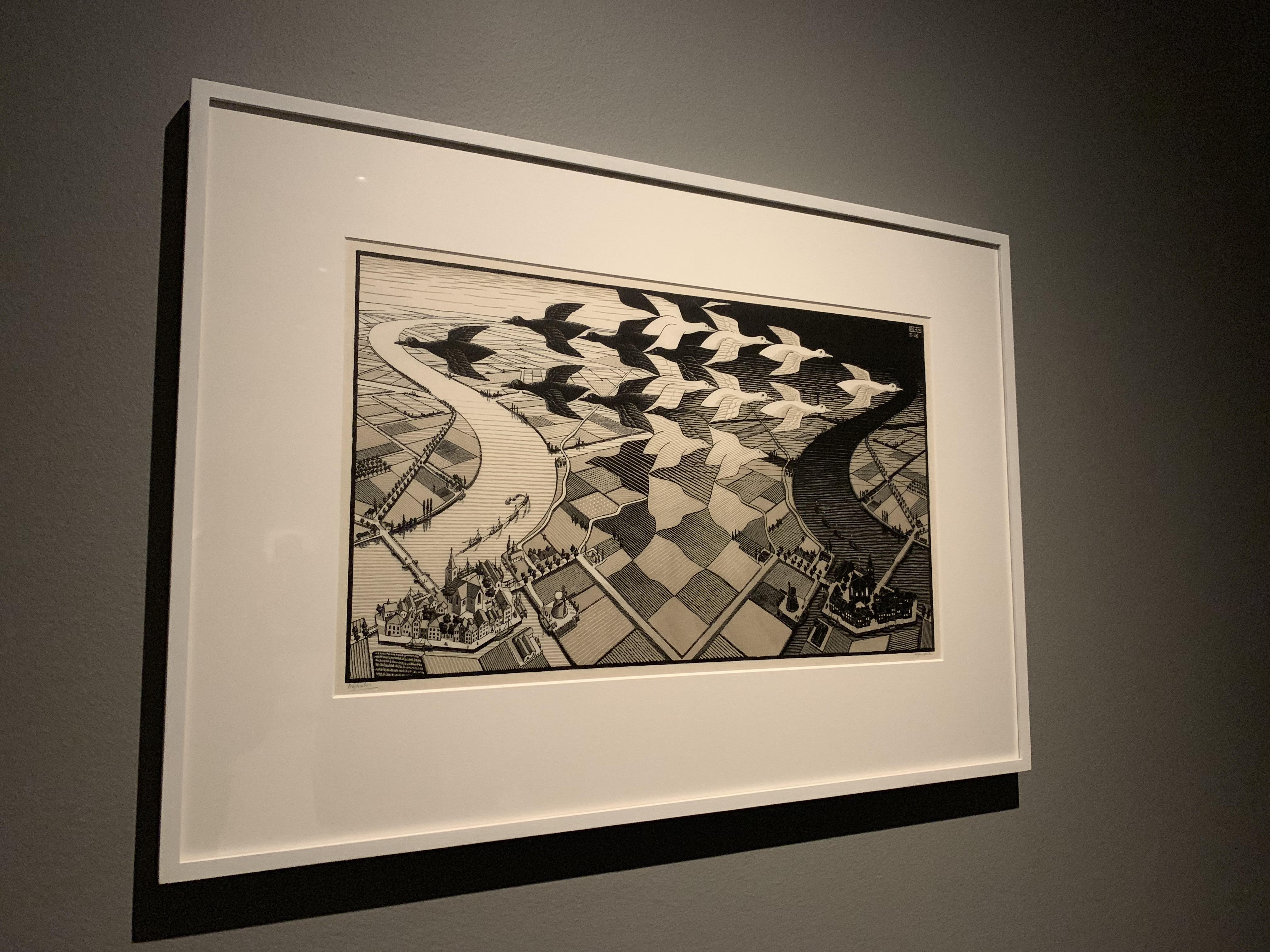
Throughout his works, Escher withdrew from the idea of drawing his surroundings in realistic and observational ways, instead, adopting an approach where he drew his “inner visions” (Poole, 2015). One of the “most famous and popular artworks” exhibited at the NGV by Escher is titled ‘Day and Night’, shown in Figure 2, which was created in 1938 (National Gallery Of Victoria, Day and Night, 1938. Escher X Nendo, Between Two Worlds Exhibition: NGV Australia: NGV Australia). This piece is a woodcut and is printed in grey and black inks. This artwork captures Escher’s passion towards the world of form and illusion. Day and Night consists of black and white birds emerging from both each other and from a chequered field, as they cross paths. This is occurring above a mirrored town with one side being night and the other day. The unusual aspect of this artwork is that viewers have to choose whether to see the foreground or the background as the division between these two aspects are intentionally blurred. Overall, this image along with many of his other works, plays with symmetry, optical illusion and dualities. Escher’s imagination strengthens the impossibility of the invented scenario.
According to the reading, “Good Taste vs. Good Design”, Good Design is initially considered as “something aesthetically pleasing or fashionable” stated Crozier (Christoforidou, Olander & Warell 2012, 185-202). This relates to Escher’s art journey as he was scorned and dismissed by the art world in the initial phases of his creations, but was instead, deeply appreciated by mathematicians. Thus, based on Croziers definition from the reading, the art world would not have viewed Escher’s designs as “good” due to them not coinciding with the popular designs and themes of the time. As the reading goes on, it is highlighted by Pye that “good design is meaningless” (Christoforidou, Olander & Warell 2012, 185-202). Pye further mentions that the level of success of a design can only be measured in relation to the intention of the designer. Within the exhibition, it was repetitively mentioned that Escher’s unique graphic expression and design themes were majorly based on portraying ideas of reflection, symmetry, cyclic repetition, transformations of shapes, optical illusions, spatial ambiguities and perspective distortions. Characteristics like these would have been Escher’s criteria for success. So therefore as the level of ‘good design’ is based upon “self evident elements of professional skill” while eradicating the opinions of practitioners, Escher would have to compare his professional skill against his own criteria to decide whether he believed his designs were ‘good’ (Christoforidou, Olander & Warell 2012, 185-202).
The way Escher was first rejected by the popular views and opinions of the art world in his initial phases of his creations is similar to the journey of the Earthworks poster collective, discussed in the reading “Earthworks and Beyond” written by Jess Berry (Berry, 182-187). Both Escher and the Earthworks collective opposed the traditional concepts within art and society. However, the topics the poster collective referenced were primarily focused on political images and ideas, differing from Escher and his focus on illusion. Jess Berry states that the poster collective presented a rare and innovative approach to arts education and that the revolutionary work they crafted influenced numerous individuals, collectives and institutions to come (Berry, 182-187). Similarly, Escher’s work has impacted and caught the attention of many individuals and the evidence of this statement is shown through the significant amount of people wanting to, including myself, pay entrance fees into this Escher exhibition to view his revolutionary work.
REFEERENCES
Berry, Jess. Chapter Eleven: Earthworks and Beyond. 182-187.
Christoforidou, Despina & Olander, Elin & Warell, Anders. 2012. Good Taste vs. Good Design: A Tug of War in the Light of Bling. The Design Journal Vol 15, no. 2, 185-202.
National Gallery Of Victoria. “M.C Escher and J.S Bach” Wall Text. Escher X Nendo, Between Two Worlds Exhibition: NGV Australia, 2 Dec 2018- 7 Apr 2019. Visited on 2 April 2019.
National Gallery Of Victoria, Day and Night, 1938. Didactic panel to accompany “Day and Night 1983 at the Escher X Nendo, Between Two Worlds Exhibition: NGV Australia, 2 Dec 2018- 7 Apr 2019. Visited on 2 April 2019)
Steven Poole. 2015. The Impossible World of Escher. The Guardian. Accessed 8 April 2019. https://www.theguardian.com/artanddesign/2015/jun/20/the-impossible-world-of-mc-escher


 Design Practices